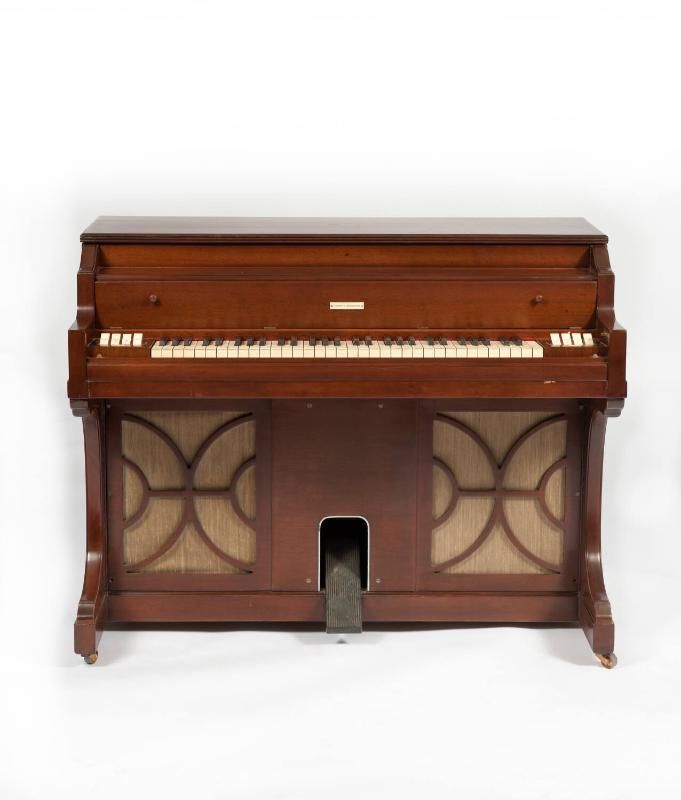
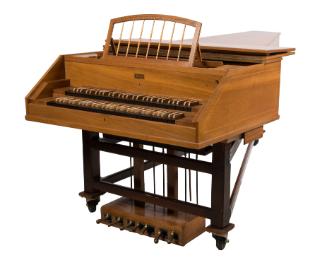
Everett Orgatron
Not available for use in Recording Studios
Not currently on exhibit
Not currently on exhibit
Artifact TypeOrgan, Reed, Electric
Manufacturer
Everett Piano Company
founded 1883
Date1935
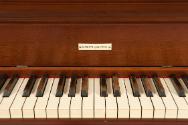
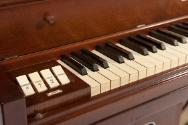
Operation/FunctionThis instrument is housed within a wooden, piano-like cabinet and contains a built-in amplification system with two loudspeakers mounted on the lower front of the instrument, covered by grill cloth. The chromatic keyboard spans a five-octave (61 notes, F-F) compass. The tone of the instrument may be adjusted via two sets of four stops, located on either side of the keyboard and corresponding to treble and bass registers. Available registrations are: Diapason 8’, Viole 4’ F, Viole 4’ MP, and Tremolo. Volume is controlled via an expression pedal located in the bottom centre of the instrument’s front.Cultural SignificanceThe cultural significance of the Hammond organ, and especially the iconic model B-3 of the 1950s, cannot be overstated. Although the Orgatron emerged at the same time, in 1935, with a strong candidate for competition in terms of innovative design, it did not achieve any degree of popular or commercial success and is among the most scarcely known of early electronic musical instruments.Technological SignificanceThe Orgatron applied an extremely innovative electrostatic approach to the design of the reed organ, which was licensed to Everett from Frederick Albert Hoschke, who developed the first iteration of the instrument in 1934 based on a patent by Benjamin F. Miessner. The electrostatic approach employed capacitance-based pickups rather than the electromagnetic pickups and tone wheels found in the newly emerging Hammond organ; capacitive pickups were not only more stable in terms of producing constant oscillation, but were also far more cost effective to manufacture. In order to engage the variable end of the capacitive pickup, Hoschke looked to the vibrating free reeds of certain types of acoustic organs. As such, the Orgatron stood as a sort of hybrid, merging acoustic tone generation with electronic modification amplification. Throughout its production period, it served as an alternative to the Hammond organ, but was plagued by an equally high price tag and an equally hefty weight, making it largely inconvenient to own. The Orgatron was also unique in that it used the reeds simply as the basis for tone generation, employing an additional series of vacuum tubes to voice and shape the output signal in various ways. Each reed was connected to two sets of pickups, each isolating different harmonic content, not unlike the design of the electric guitar. One major drawback to the Orgatron was that its voicing was enabled by a keyed-generator system, meaning that the reeds did not move, and thus generate an electrical signal, until engaged by the key. The result of this design was a slow response, or, in other words, a delay between when the key is depressed and when the final output sound is heard. When the technology was passed to the Wurlitzer Company in 1941, this design was switched to a free-running system in which voicing of the key is connected to the audio signal itself rather than the reed. The Orgatron also suffered basic construction issues, prone to extraneous noises derived from poor insulation and the high voltages required to drive the electrostatic pickups.
Both the Hammond organ and the Orgatron, which emerged in 1935, were preceded by several other efforts in the design of electronic organs. The first of these is usually considered to be Thaddeus Cahill’s Telharmonium, which emerged in 1897. The Telharmonium was a tremendously unwieldy instrument, consisting in enormous rotating electromagnetic alternators as tone generators at a time before even the vacuum tube had been invented and more streamlined amplification methods had been implemented. The instrument was highly unconventional in its design, fashioning cones out of several telephone receivers to act as a primitive loudspeaker, and employing telephone wires to broadcast its signals into the listener’s home. The first true commercial electromechanical organ came in 1928 with Frank Morse Robb’s wave organ. Robb, a Canadian inventor, employed a series of large metal discs, each with a particular waveform edged around its circumference, derived from recordings of an acoustic pipe organ projected onto an oscilloscope. These discs were organized onto twelve metal shafts and rotated by a motor when in use; the speed at which the discs rotated determined the octave in which they sounded. As with the Hammond organ, Robb’s organ employed a series of electromagnets acting as pickups to amplify the signal. Perhaps the main difference between Robb’s design and Hammond’s, however, is that the tone wheels of the former were each edged to imitate specific timbres. As such, only preset sounds could be selected. Hammond’s tone wheels all produced simple sine tones, but the addition of an innovative and flexible drawbar system of layered overtones allowed the player of the Hammond organ to employ an additive synthesis process so as to construct their own timbres. It is important to note that although instruments such as the Hammond organ and Telharmonium are colloquially classified as ‘organs’, they contain no acoustic sound generating components nor do they function by the flow of air across a column or reed; as such, in the most technical sense of the term, they are not in fact organs. In this understanding, the Orgatron was essentially the first true electrified organ.Users/PerformersThere is no documented usage of the Orgatron in popular music, either in live or recorded contexts.Collection
Object number2000.05.13
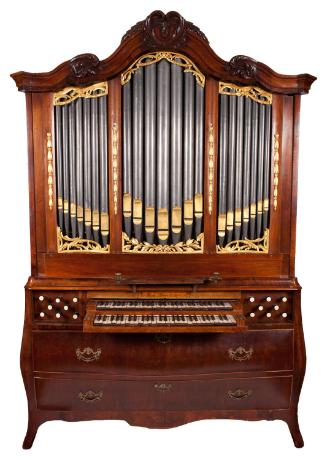
Hendrik Anthonie Meijer
1785
Not available for use in Recording Studios
On View: Not currently on exhibit
isVirtual:
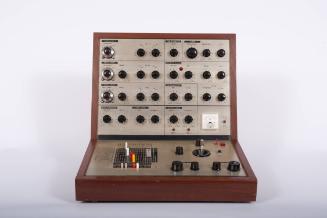
Electronic Music Studios (London) Limited
1969
Not available for use in Recording Studios
On View: Not currently on exhibit
isVirtual:
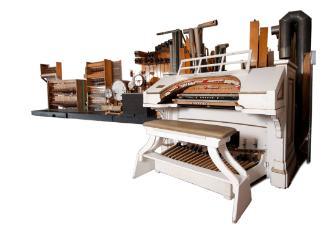
Kimball Piano and Organ Company
1924
Not available for use in Recording Studios
On View: On exhibit
isVirtual:
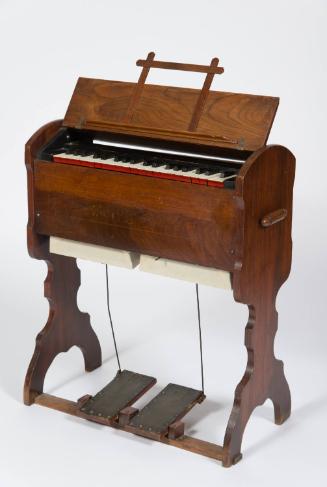
Mason & Hamlin Organ & Piano Company
1890
Not available for use in Recording Studios
On View: On exhibit
isVirtual:

Eric Herz
1976
Not available for use in Recording Studios
On View: Not currently on exhibit
isVirtual:
Kurt Wittmayer
1954
Not available for use in Recording Studios
On View: Not currently on exhibit
isVirtual:

Baldwin Piano and Organ Company
1966
Available for use in Recording Studios
On View: Not currently on exhibit
isVirtual:
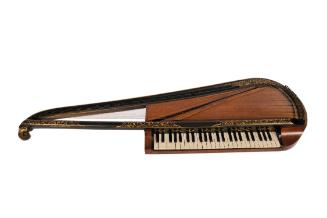
Carl (Karl) Leopold Röllig
c. 1800
Not available for use in Recording Studios
On View: Not currently on exhibit
isVirtual:

Optigan Corporation (of Mattel) / Opsonar (of Miner Industries)
c. 1973
Available for use in Recording Studios
On View: Not currently on exhibit
isVirtual:
Bösendorfer Klavierfabrik GmbH
1855
Not available for use in Recording Studios
On View: Not currently on exhibit
isVirtual:

Hohner Musikinstrumente GmbH & Co. KG
c. 1950
Not available for use in Recording Studios
On View: Not currently on exhibit
isVirtual:

Bode Sound Company
1977
Available for use in Recording Studios
On View: Not currently on exhibit
isVirtual: