EN / FR
Skip to main content

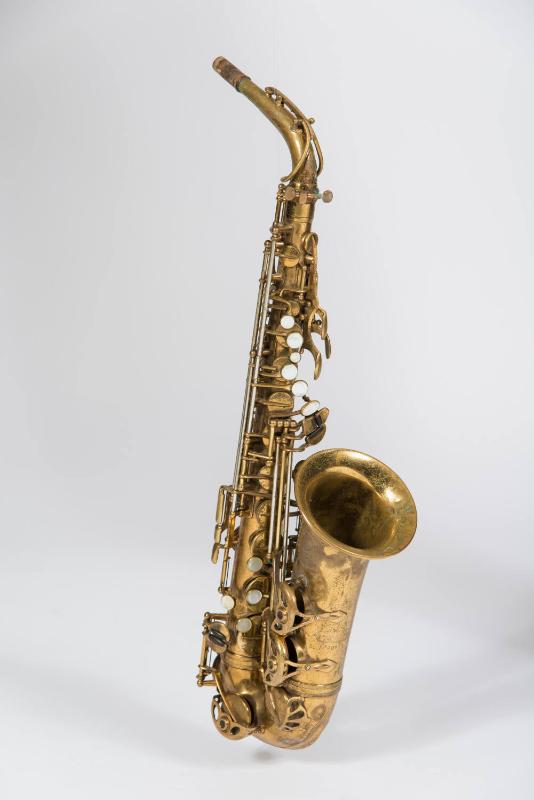
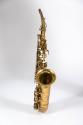
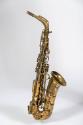
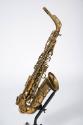
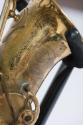
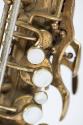
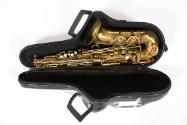
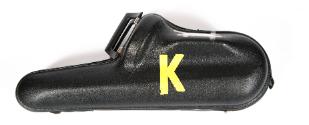
Mart Kenney Alto Sax

Not available for use in Recording Studios
Not currently on exhibit
Artifact TypeSaxophone
Manufacturer LocationFrance
Datec. 1935

This alto sax was owned by Canadian jazz musician and big band leader Herbert Martin “Mart” Kenney. Kenney’s band, His Western Gentlemen, was considered the leading dance band of the 1930s and ’40s. Making over 25 records for RCA by 1951—the band attributed the appeal of their versatile sound to the fact that it was neither too “sweet” nor too “swinging.” The band’s theme song, “The West, A Nest, and You Dear,” was one of the most popular Canadian hits of the World War II era.


Donated by the Kenney family

Operation/FunctionThis particular instrument is an alto saxophone that contains a mouthpiece and reed component and as well as approximately twenty toneholes.Cultural SignificanceUnlike most other woodwind instruments, the saxophone is not regarded for its inclusion in the classical repertoire. It remains one of the most iconic instruments used in jazz music, lauded for its commanding tone. Many of this genres most respected musicians were saxophonists, including John Coltrane, Charlie Parker, Ornette Coleman, Pharaoh Sanders, Cannonball Adderley, Stan Getz, Sonny Rollins, and Sidney Bechet. With its curved U shape, the alto saxophone is perhaps the most recognizable member of the instrument family.Technological SignificanceThe emergence of the saxophone in the 1840s is attributed to the Belgian instrument builder Adolphe Sax. Despite having structured the design in 1840, the first patent was not received until 1846. Sax’s intention was to produce an instrument that could project as strongly as the brass, but incorporate the flexible fingering arrangement of the woodwinds. His experimentations on the saxophone were born of improvements he had implemented into the bass clarinet. His first designs outlined two separate groups of the instrument, each with seven members varying in transposition and size. These two groupings are usually referred to as the concert series, including instruments such as the soprano and alto pitched to B-flat and E-flat, and the orchestral series, which contains the only saxophone pitched to C. Although the saxophone shares many acoustic and design characteristics with the clarinet, such as a conical bore shape and the use of a single reed, the two instruments vary in several fundamental ways concerning the size of the reed and the fingering system employed. From the 1860s onward, numerous saxophone manufacturers began applying improvements to design, including extending the range and incorporating alternate fingerings.Users/PerformersThis particular artifact was formerly owned by Canadian jazz musician and big band leader, Mart Kenney. Kenney was born Herbert Martin Kenney on 7 March 1910 in Toronto, Ontario and began playing both clarinet and saxophone at an early age, performing throughout Toronto and, later, Vancouver, British Columbia. He formed his first and most well-known dance band, The Western Gentlemen, in 1931 with Glen Griffith (trumpet, piano), Jack Hemmings (trumpet), Bert Lister (saxophone), Hec MacCallum (bass), and, later, Ed Emel (percussion) and Art Hallman (saxophone, vocals, piano). The group debuted on CJOR radio in 1934 and began a three-year seasonal performance contract at the Waterton Glacier International Peace Park in southern Alberta. Airplay on CBC radio throughout 1934 led to cross-Canada tours with regular performances at Canadian Pacific Railway hotels including Vancouver’s Hotel Vancouver and Toronto’s Royal York Hotel. A recording contract with RCA emerged in 1938, having produced approximately twenty-five 78s by 1951. The number of musicians in the group, which had relocated in 1940 to Toronto and come to be known simply as Mart Kenney and His Western Gentlemen, varied over the following years, expanding at its largest to 30 members. Although their popularity remained centered in Canada, broadcasts of their recordings were picked up by CBS and NBC in the United States and by the BBC in the United Kingdom. Kenney shifted into retirement in 1969, settling in Mission, British Columbia. Although his group was no longer active during this time, Kenney himself continued to make guest appearances in the metro Vancouver area throughout the 1970s and 1980s. Among his awards and recognitions are the member of the Order of Canada (1980), and an honorary LLD from the University of Lethbridge (1985). Kenney passed away on 8 February 2006. The music of Mart Kenney and His Western Gentlemen was regarded as being neither too “sweet’ not “swinging”, leaving their greatest impact on the public during the war years. Their most successful release remains The West, a Nest, and You, Dear, which was recorded for RCA in 1938.
Object numberT.2016.09.01
Photo credit: Don Kennedy
Henri Selmer Paris
c. 1930
Not available for use in Recording Studios
On View: On exhibit
isVirtual:
Photo credit: Don Kennedy
Buescher Band Instrument Company
1923
Not available for use in Recording Studios
On View: On exhibit
isVirtual:
Photo credit: Don Kennedy
Drum Workshop, Inc.
2009
Not available for use in Recording Studios
On View: On exhibit
isVirtual:
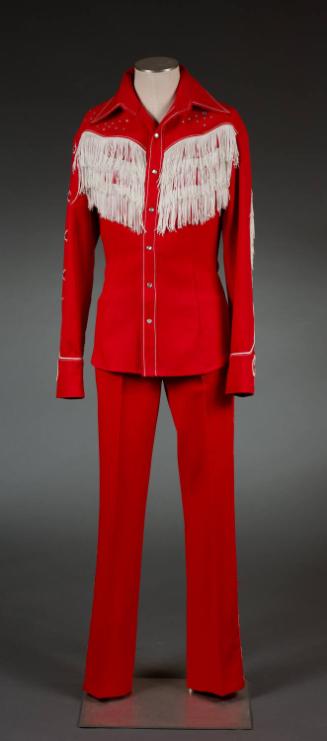
Photo credit: Don Kennedy
Gerri Schneider
20th Century
On View:
isVirtual:
Photo credit: Don Kennedy
Selmer (UK)
1957
Available for use in Recording Studios
On View: Not currently on exhibit
isVirtual:
Back